
“I didn’t fail. I discovered 34 ways that don’t work to trailer the horse!” I told them. But allow me to start from the beginning.
Success and failure are relative measures. Success boosts one’s self-confidence and improves subsequent performances. However, failure toughens one up and increases persistence in the face of future mishaps.
Going from one success story to the next feels good, but it may give one a false sense of security. On the other hand, moving from one failure to the next isn’t good for one’s morale. So what’s the best? I will tell you a short story.
Once, when I was young and never said no to a new challenge, I accepted a job of trailering a horse. Horse trailering was once the number one problem reported by horse owners, much as the home-alone problem is for dog owners, and inappropriate urination and defecation are for cat owners.
Trailering a horse, or not being able to do so, can be a considerable problem. If it happens when you’re at home, it’s annoying that you can’t move the horse, but that’s what it is. When you’re out with your horse, 300 miles away, and you can’t take your horse home, then you’ve got a real problem.
These horse owners had the horse 200 miles from home. They went out for some kind of equestrian event, and when it was time to drive back home, the horse refused to get into the trailer. Try as they might, they couldn’t get the horse into the trailer. Finally, they gave up, left the horse in a stall, and drove home. That’s when I came in. They called me, offering me all I wanted if I could just get their horse home. After hearing how many horsemen and how they had tried to solve the problem, I should have refused. As I said, I was young and thrived on challenges.
I drove up to the farm where the horse was. We let it free in a small arena, drove a trailer in, and I sat on the fence just watching the animal. It was a beautiful quarter horse mix, a mare, about four years old. The owner told me the horse’s story: no problems except trailering. They succeeded in one of maybe 20 tries, but only after much hassle, and it was getting worse.
I will spare you for all the different methods (if you can call them such) they have used while trying to solve the problem—a long list of force and abuse that have nothing to do with horse training, just reflecting human frustration and thoughtlessness. Don’t get me wrong: the owners were not bad people. They were friendly and educated. They had just been poorly advised.
Some dog people, these days, get their blood pressure up from hearing a faint whine from a dog, and they fight bitterly over which collars are right and which ones are so totally wrong. Well, visit the horse world from time to time, and I promise you you’d begin focusing on what is essential and would not even give a thought to minor deviations. Except for a few (and marginalized) brave horsemen and women attempting to show that there are other equally (or more) efficient ways to handle a horse than sheer force, I’m sorry to have to say it. However, horse training is still a long narrative of abuse masked under the names of fancy techniques.
I stepped into the arena bare-handed, not even carrying the horseman’s tool number one, his rope. I liked the mare straight away. It’s with animals, like with humans, some you have that feeling of liking instantly, and others, unfortunately, not. I think she liked me, too, if not right away, then maybe 10 minutes after we both just walked slowly around, each tending our own business, pretending not to be bothered at all by the other. The owners left at some point, having to run errands downtown, which I think suited us both (horse and me) perfectly well.
After a while, the horse came to me, and we stood for a moment just deeply inhaling and exhaling. This is a horse thing when they meet others. When in Rome, be a Roman. So, when I’m with a horse, I become as horsey as I can. It may look silly for some, but it works for me.
We walked around in the quiet arena for about two hours. We had a great time. The owners came back and asked me if I had had the horse in the trailer.
“No,” I answered shortly.
“Oh, we’re sorry you’ve failed and wasted your time,” they replied as offering their condolences.
“I didn’t waste my time. I didn’t fail. I discovered 34 ways that don’t work to trailer the horse.” I replied.
A few hours later, both the horse and I were in the trailer, eating carrots and happily inhaling/exhaling one another. Not at one time did I use a rope or the halter, not once did I touch the horse. The first time we had body contact was when we had been in the trailer for a while and had eaten three to four carrots.
That day, I learned how to trailer a horse, not because I succeeded after four hours, but because I had found 34 ways that didn’t work. I thought I knew it before, but I didn’t. My early success had just lulled me into a false sense of security.
Success and failure are in our minds. It’s all a question of criterion and attitude.
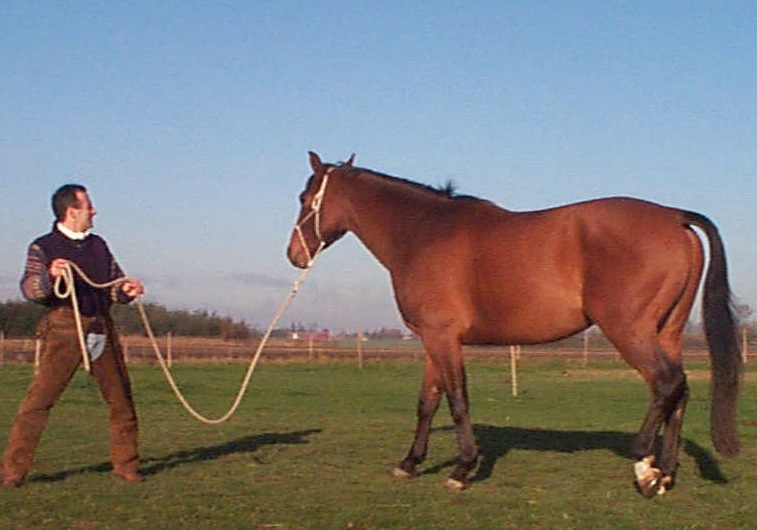
Featured image: Roger Abrantes working with horse—Body language and movements are very important when communicating with any animal. Horses are particularly sensitive to motion and stance (photo from the EI files).
Featured Course of the Week
Ethology Ethology studies animal behavior in its natural environment. It is one of the fundamental courses in your curriculum. A reliable knowledge of animal behavior is the basis to create a satisfying relationship with any animal we train.
Featured Price: € 168.00 € 98.00
Learn more in our course Ethology and Behaviorism. Based on Roger Abrantes’ book “Animal Training My Way—The Merging of Ethology and Behaviorism,” this online course explains and teaches you how to create a stable and balanced relationship with any animal. It analyses the way we interact with our animals, combines the best of ethology and behaviorism and comes up with an innovative, yet simple and efficient approach to animal training. A state-of-the-art online course in four lessons including videos, a beautiful flip-pages book, and quizzes.